The Grape Varieties Powering English Wine (And Where to Try Them)
13 Aug 2026 · By Stephen Pritchard in Wine Guides
England now has 4,841 hectares under vine, planted with 99 different grape varieties. Three of them, all originally from Champagne, still account for roughly seven vines in every ten. But the other 96 are where things get interesting: producers experimenting with rare grapes, disease-resistant hybrids and international varieties to work out what this country's climate is actually good at. Here's what's planted, what's winning awards, and which bottles are worth seeking out.
What's planted, and how fast it's changing
The numbers come from WineGB's 2025 Industry Report, based on Food Standards Agency data. England accounts for 4,489.78ha of that total, with a further 91.4ha in Wales. Growth has been steep: from 875ha in 2000, dipping slightly to 793ha in 2005, then climbing to 1,324ha (2010), 1,956ha (2015), 3,758ha (2020) and 4,841ha (2024), a rise of 510% since 2005. WineGB's own projections put the country on course for around 7,600ha by 2032.

Vineyard events, new openings and the best deals - straight to your inbox.
No spam, unsubscribe anytime.
 Instagram
 TikTok
The top ten varieties by area planted:
- Chardonnay – 1,498ha
- Pinot Noir – 1,370ha
- Pinot Meunier – 411ha
- Bacchus – 334ha
- Seyval Blanc – 123ha
- Solaris – 117ha
- Pinot Gris – 80ha
- Reichensteiner – 65ha
- Rondo – 64ha
- Pinot Blanc – 54ha
Beyond that top ten, the list gets long and often just a hectare or two deep: Sauvignon Blanc (37ha), Gamay (8ha), Albariño (4.5ha), Merlot (3ha) and Riesling (2ha) all have a foothold, alongside tiny experimental plots of Cabernet Sauvignon, Cabernet Franc, Chenin Blanc, Gewürztraminer, Grenache, Marsanne, Nebbiolo, Pinotage, Savagnin, Syrah, Tempranillo and Viognier.
Don't expect most of those last few to become mainstream any time soon. England's growing season has lengthened with a warming climate, but late-ripening, thick-skinned Mediterranean reds like Syrah, Tempranillo and Grenache still need more sustained heat than this country reliably offers. The grapes that dominate the top ten do so because they're proven: Chardonnay and Pinot Noir ripen early enough to handle a short season, and Bacchus and Seyval Blanc were bred or selected specifically for cool, damp conditions.
Chardonnay, beyond the sparkling blend
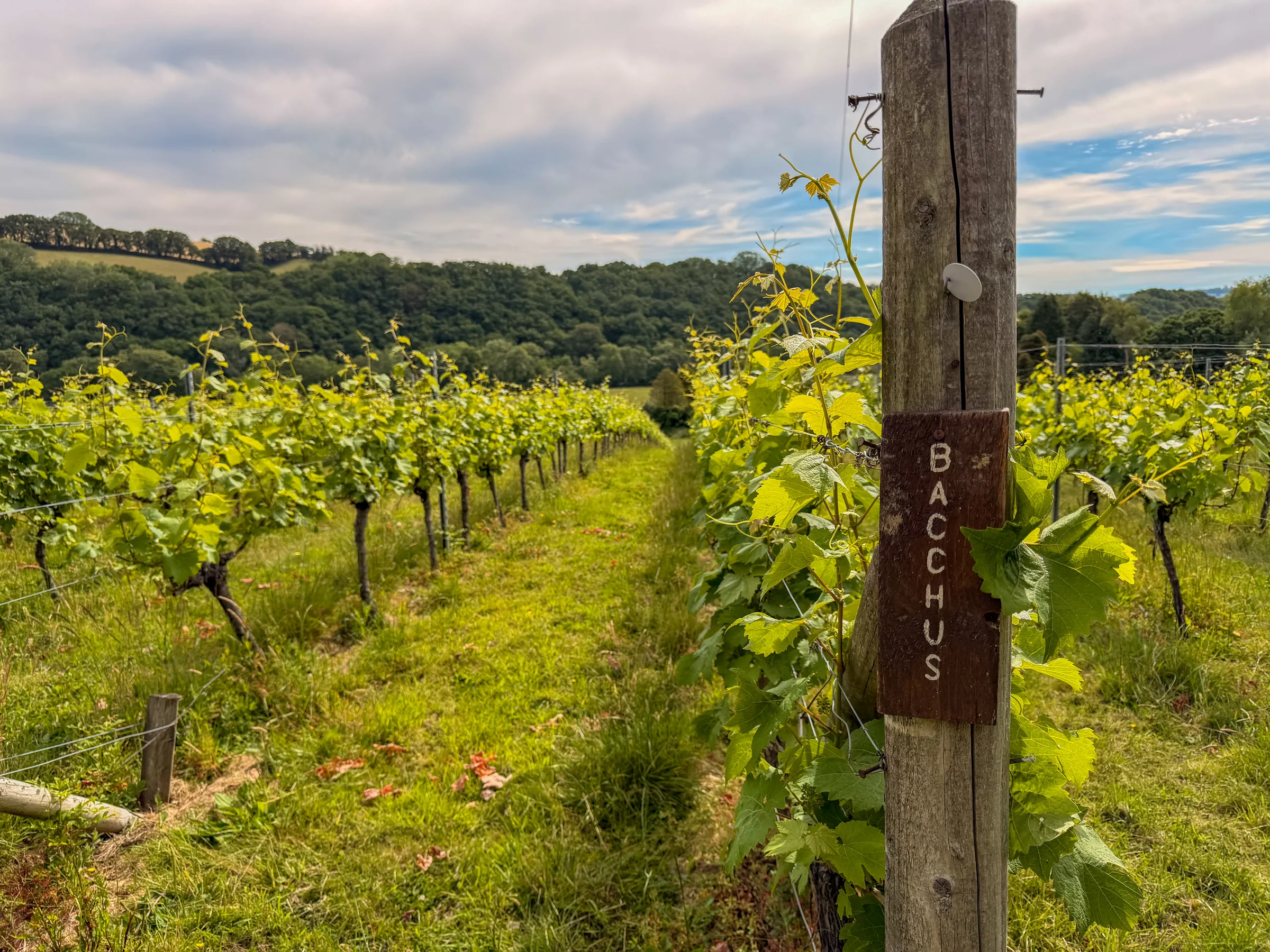
Most English Chardonnay ends up in a sparkling blend, but a small and growing number of producers bottle it still, and some let it ferment on wild yeast rather than a cultivated strain. Wild fermentation is slower and less predictable than using a commercial yeast, which is why it's almost always done in small batches with close attention to each barrel.
Try it: High Weald's Wild Ferment Chardonnay (unfined, unfiltered, aged 12 months), or Nutbourne's Barrel Fermented Chardonnay, left to ferment naturally rather than with an inoculated yeast.
Award winners: the Big Three, and how the balance is shifting
Traditional method, the same technique used in Champagne, still accounts for 91% of all English sparkling wine production. Among the medal-winning sparkling wines in our own awards records, roughly two-thirds are blends and just over a third are single varietal, and the classic three-way mix of Chardonnay, Pinot Noir and Pinot Meunier remains the single most common combination behind a trophy. Nyetimber's 1086, Wiston Estate's Vintage Cuvée Magnum and Chapel Down's Rosé were all built on that blend when they won trophies at the International Wine Challenge in 2025 and 2026.
But look at single-varietal wins specifically, and the balance has shifted noticeably in just five years:
| Grape | 2022 | 2023 | 2024 | 2025 | 2026 |
|---|---|---|---|---|---|
| Chardonnay | 18 | 21 | 20 | 25 | 33 |
| Pinot Noir | 10 | 8 | 7 | 3 | 6 |
| Bacchus | 1 | 2 | 7 | 5 | 6 |
Chardonnay's single-varietal wins have nearly doubled since 2022, while Pinot Noir's have fallen back. Rarer whites are also starting to place: Sauvignon Blanc, Albariño, Gamay and Ortega only began picking up single-varietal medals from 2025 onward.
That Sauvignon Blanc shift is worth pausing on. Bacchus has long been marketed, IWSC among others, as England's answer to Sauvignon Blanc: a cool climate lifts its acidity into something genuinely reminiscent of it. But the comparison has critics. Some of Sauvignon Blanc's signature aroma compounds simply aren't present in Bacchus, and its floral character arguably owes more to its actual parent grape, Riesling. Meanwhile the same award data above shows English Sauvignon Blanc itself finally picking up medals, from Balfour, Greyfriars, Woodchester Valley and Abingworth. It may not need a substitute for much longer.
Pinot Noir
Typically: red cherry, redcurrant and an earthy, savoury edge, closer to a cool climate Burgundy than the riper, more fruit-forward style you might expect from California or New Zealand.
Try it: Charles Palmer Vineyards' Pinot Noir, which won Decanter Silver in 2026.
Seyval Blanc
Typically: green apple and citrus, with a naturally high acidity that suits both a crisp still white and a long-aged traditional method sparkling.
Try it: Breaky Bottom's Seyval Blanc cuvées. One of England's longest-established small producers, they've picked up WineGB gold for it in both 2023 and 2025.
Sparkling beyond the blend
Traditional method dominates, but it isn't the only way English producers make their wine fizz. Charmat, or tank method, accounts for around 6% of sparkling production: the second fermentation happens in a pressurised tank rather than the bottle, which is faster, cheaper, and keeps the fruit brighter and less bready than a long lees-aged traditional method wine. Chapel Down's A Touch of Sparkle range and Silverhand Estate's Silver Reign both use it, and Flint Vineyard's Charmat NV is an unusual example: a four-way blend of Sauvignon Blanc, Chardonnay, Bacchus and Seyval Blanc, rather than the usual Champagne trio.
Pét-nat, sometimes called col fondo, is smaller again at under 2% of production, but it's where some of the more experimental varietal choices show up. The wine is bottled before its first fermentation finishes, so the sparkle happens naturally and the result is often cloudy and less polished than a traditional method wine. Westwell, Davenport and Sedlescombe all make one; Little Waddon's versions lean on Regent, a PIWI red grape rarely seen used any other way.
Chardonnay, differently
Typically: green apple, citrus and brioche in the classic blend, but on its own and made pét-nat, it comes out brighter, cloudier and less polished, closer to a natural wine than a Champagne-style fizz.
Try it: Westwell's Petulant Nature Chardonnay, a 100% Chardonnay pét-nat.
If you want the full picture on how these methods actually differ in the glass, that's a piece in itself, coming soon on Grapevine.
The rare and unusual
Some varieties are planted so sparingly they're really a single producer's project rather than a category. Merlot is the clearest example: just 3ha nationally, right at the edge of what England's climate can ripen reliably. Bluebell Vineyard Estates' Ashdown Boundary Block Merlot, 100% Merlot aged 19 months in old oak, is a fair showing of what's possible: perfectly drinkable and well made, but a curiosity rather than a wine serious Merlot drinkers will buy by the case. England isn't Bordeaux, and at 3ha of planting nationwide, nobody involved is pretending otherwise.
Riesling is almost as rare, at 2ha nationally. Biddenden Vineyards in Kent, one of the country's oldest commercial vineyards, only planted theirs in 2018, a recent addition to a five-decade-old estate.
Albariño, at 4.5ha, is newer still to England, but already winning: Savage Vineyard's Four Daughters Albariño took WineGB gold in 2025. Ortega, an earlier and altogether more established German crossing, has become something of a house style at Biddenden, who also grow Schönburger and Gamay Noir, the latter picking up a WineGB silver in 2026.
International roots: French and German varieties
Beyond the Champagne trio, England's vineyards carry a handful of other French names. Gamay, best known from Beaujolais, turns up at Biddenden and as a blending component in Bolney's trophy-winning Cuvée Rosé. Sauvignon Blanc, discussed above, is on the rise. Chasselas, a Swiss and French table and wine grape, appears in small quantities at Bluebell.
The German influence runs deeper and further back. Riesling aside, most of England's German-origin varieties are crossings bred decades ago specifically for cool, marginal climates: Reichensteiner (65ha, the 8th most planted variety in the country) shows up in blends like Biddenden's Gribble Bridge range; Schönburger and Siegerrebe both add aromatic lift to white blends across the country. None of these are true PIWI hybrids in the strict sense, they were bred for reliability in a short season rather than disease resistance specifically, but they share the same underlying logic: match the grape to the climate, not the other way round.
PIWI: the disease-resistant hybrids gaining ground
PIWI is short for the German "pilzwiderstandsfähig", meaning fungus-resistant. These are varieties bred by crossing Vitis vinifera with other Vitis species specifically to build in natural resistance to powdery and downy mildew, the two fungal diseases that cause the most damage in England's damp climate. Growers report needing up to 80% fewer fungicide treatments as a result, a genuine sustainability and cost advantage in a climate this challenging to farm organically.
Two PIWI varieties are already firmly established in England's top ten: Solaris at 117ha (6th most planted overall) and Rondo at 64ha (9th). They're strongest outside the traditional South East heartland. Solaris is the single most planted variety in the Midlands and North, and second most planted in Wales, regions where Chardonnay and Pinot Noir struggle more with a shorter, cooler season.
Solaris
Typically: green apple and tropical fruit, usually made off-dry to dry. Its very high natural sugar potential also makes it a good late harvest grape, though not a noble rot one: Solaris actually resists botrytis, so any sweetness comes from extended ripening on the vine rather than fungal concentration.
Try it: Burn Valley Vineyard's Solar Late Harvest, hand-picked at peak ripeness in Norfolk.
Other PIWI reds and whites turn up across the country in smaller amounts: Regent (Little Waddon, Burn Valley's Marsh Red), Phoenix (Blabers Hall, Fleur Fields) and Souvignier Gris are all becoming familiar names to growers looking for a lower-spray, lower-carbon way to keep vines healthy through an English summer.
Where to try them for yourself
Three grapes still define most of what ends up in an English glass, but the other 96 are where the country's wine is genuinely finding its own identity. Use Vinebound's vineyard finder to plan a visit, or browse a nearby area guide to find several of the producers above within a single trip.